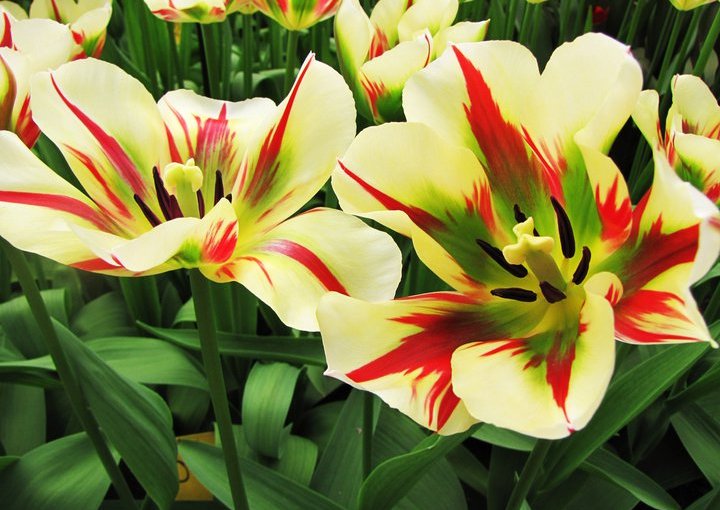
Bulbs are beautiful yet short lived by producing a great floral display at once, storing food for the following year, then becoming dormant. The bulb itself is essentially a large storage organ. For successful blooms the following year the foliage must be allowed to ripen naturally and not be cut back until it dries and turns brown. Inter-planting with other attractive plants helps disguise dying foliage. Botanists and horticulturalists refer to this group as ‘geophytes’ which is a plant with a bulb, tuber, corm or some other storage structure. Bulbs are typically most widely seen in spring eg. tulips and daffodils, but there are some summer bulbs like lilies and autumn bulbs such as Colchicums. Bulbs can be used in beds, woodland, lawns and containers. Sweeps of vibrant bulbs add colour to perennial borders while other plants are dormant. The vast majority of bulbs are planted or transplanted when dormant. Small bulbs can be planted with a bulb planter that removes a small plug of the soil. For larger bulbs a large fuel powered drill can even be used or long handled bulb planter.

 Get Planting!